Elmer Crowell Early Wood Duck Drake
A. Elmer Crowell (1862-1952) East Harwich, MA, c. 1912
The catalog record
A. Elmer Crowell (1862-1952) East Harwich, MA, c. 1912 12 in. tall on base and 16 3/4 in. long
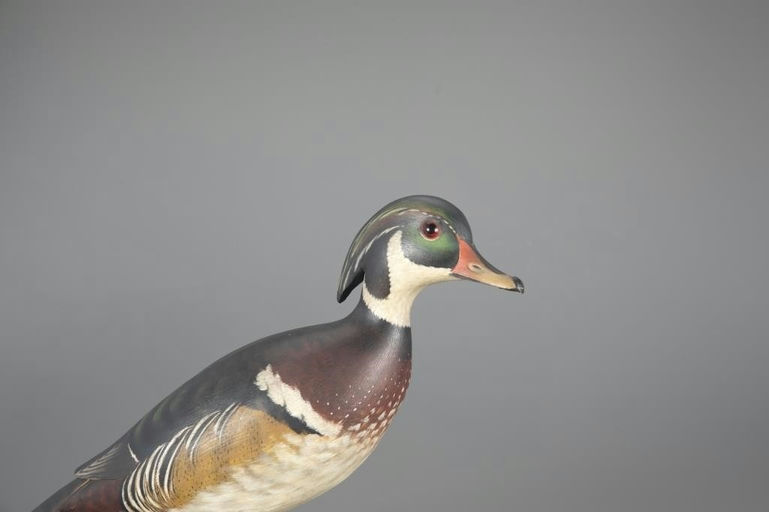
This is one of the finest Crowell decorative carvings to ever come to market. Only two early comparable examples of these oval-brand standing wood ducks are known. One very similar example is featured in the Thomas M. Evans Jr. Collection and the other is in the Jim and Diane Cook Collection.
Wood duck drakes are known for their striking plumage and Crowell rose to the challenge, recreating their ornate feathering and regal form. Crowell had access to live wood ducks, including those kept by Dr. John C. Phillips. Having a live example of this shy species was particularly valuable during an era when population numbers in the wild were especially low. In 1918 the Migratory Bird Treaty Act placed a moratorium on hunting the species; they have since become one of the great conservation success stories.
Crowell had an interest in educating through his carvings; his concern over the extinction of the wood duck likely motivated him to preserve this species by making a carving that displayed his finest work. Indeed, the refinement, detail, and execution seen on this drake remains unsurpassed. Beyond his standard blending and wet-on-wet techniques, nuanced paint details, such as the white-on-white feathering seen in the cheeks and breast, are related to the iconic preening Canada goose which was made around this time. Other subtleties include the extremely fine red feathering on the blended head and neck and the single golden feather flanking the base of the tail.
The well-proportioned body has a bold upright posture, subtle wing contours along the back, raised wing tips, and a thin notched tail. The turned head and crest on this bird stand out among Crowell’s works for his ability to capture the summer duck’s distinct head shape. This achievement is shared with Canada's Thomas Chambers, who is also noted for his wood duck heads. The maker’s crisp oval brand signature is impressed in the bottom of the base.
New research has revealed that this mantel bird was made for an important Boston-area Crowell patron. It remained in that family for over eighty years and made its public debut in 1995 at Van Blarcom Auctions. Excellent original paint with very light wear from handling, including one minor paint rub on left wing. Minor chipping to toe tips. Very small repair under bill tip.
Provenance: Private Collection, Massachusetts, by descent from the original Crowell patron Private Collection, Cape Cod, acquired 1995 Private Collection
Literature: Brian Cullity, "The Songless Aviary: The World of A. E. Crowell & Son," Sandwich, MA, 1992, p. 83, pl. 46, p. 50, color plate V, similar carving illustrated, p.117, pl. 129, Cook collection carving illustrated.
Stephen B. O'Brien Jr. and Chelsie W. Olney, "Elmer Crowell: Father of American Bird Carving," Hingham, MA, 2019, p. 200, closely related Evans collection example illustrated.
Copley Fine Art Auctions, "The Sporting Sale 2011," Plymouth, MA, July 2011, lot 673, exact decoy illustrated.
Kenneth W. Van Blarcom Auctioneers and Appraiser, "The Early Spring Auction Catalog," March 25, 1995, front cover and lot 7A, exact decoy illustrated.
Provenance
Private Collection, Massachusetts, by descent from the original Crowell patron Private Collection, Cape Cod, acquired 1995 Private Collection
Comparable sales
The 5 most recent Elmer Crowell Wood Ducks to cross the block.
| Sold | Condition | Paint | Brought |
|---|---|---|---|
| 26 Sep 2026 | — | — | $2,040 |
| Jul 2026 | Excellent | Original | $570,000 |
| Jul 2026 | — | Original | $2,400 |
| Apr 2026 | Excellent | Original | $51,000 |
| Apr 2026 | Excellent | — | $2,400 |
Same maker and species, most recent first. Prices include the buyer's premium. All Elmer Crowell sales