John Haff Reaching Curlew
Capt. John Haff (1868-1909) Cobb Island, VA, c. 1890
The catalog record
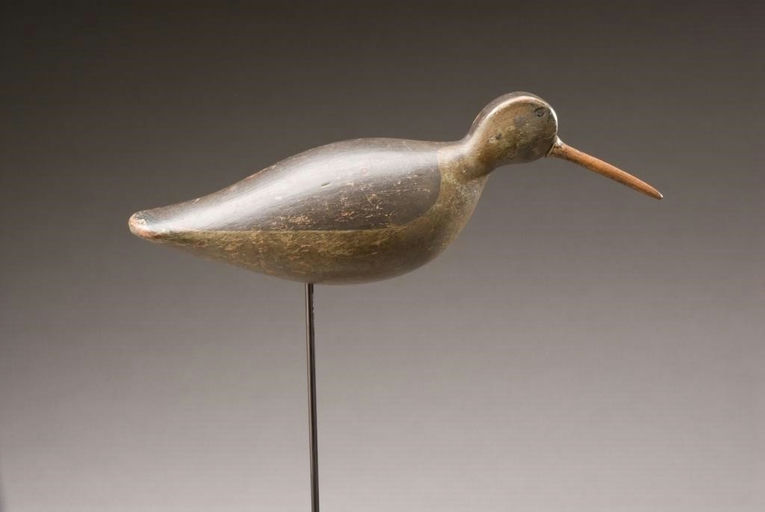
Capt. John Haff (1868-1909) Cobb Island, VA, c. 1890 Like the maker himself, this boldly carved shorebird decoy has strong features, closely resembling the work of Nathan Cobb Jr. The belly of the bird measures a full 12 inches in circumference. The head, similar to lot 469, has full cheek carving with subtle eye grooves and incised eyes. The similarities between the two decoys continues with each bird essentially the same length and retaining nearly identical wing patterns. The primary variance between the two carvings is revealed in the tail section, where Haff chose a broader tail, perhaps to prevent breakage which is often seen in Cobb Island shorebirds. Of Capt. John Haff, William J. Mackey, Jr. in "American Bird Decoys" writes, "Most famous of the Cobb guides was John Haff, [a] man who became a legend in his own life time. Haff was dragged half dead from the Cobb Island surf about 1860. He was apparently in his twenties and seemed to be a Hollander, though no word of his origin or of the cause of his narrow escape from death ever passed his lips. The island became his home, and his loyalty and devotion to the Cobbs were unquestioned. "There are men still alive who had seen him take a white potato in each hand and crush them to a pulp. When potatoes were in short supply, he would do the same with two hard clams... Haff preferred potatoes, though, as the sharp, hard clamshells cut his hands severely on several occasions. "Such incidental and offhand exhibitions as these took second billing to John Haff's regular Sunday morning show on the front lawn of the boardinghouse. At these demonstrations he would direct his attention to a tremendous ship's anchor weighing 1,000 pounds, which had been salvaged and now served as an ornament. With a minimum of huffing and puffing, Haff would lift the anchor clear of the ground and walk a few steps with it. After this Herculean effort Johnny Haff would mingle with the guests and help amuse them with other stunts and conversation. Sunday was a rest day and no hunting was allowed." Haff would quickly become famous for not only his strength, but also his hunting prowess and exceptional decoys of which there are very few known. Perhaps the finest Haff decoy and certainly one of the greatest Virginia shorebird decoys to ever come on the market. Painted on the underside "John Half, Hog Island, died 1900 - strongest man in VA." Retains Mackey Collection ink stamp. Original paint with even gunning wear and slight flaking along grain lines. A small area of touchup to right side of head. Original oak bill retains remnants of original paint.
Provenance: William J. Mackey Jr. Collection Donal C. O'Brien Jr. Collection
Literature: Henry A. Fleckenstein, Jr., "Southern Decoys, of Virginia and the Carolinas," Exton, PA, 1983, pp. 160-161, 171, plate. 305. Paul A. Johnsgard, "The Bird Decoy: An American Art Form," Lincoln, NE, 1976, p. 155. Richard A. Bourne Co. Inc., "Collection of the late William J. Mackey, Jr.," Hyannis, MA, July 17, 1973, lot 158, exact bird illustrated. William J. Mackey, Jr., "American Bird Decoys," New York, NY, 1965, pp. 153-154.
Provenance
William J. Mackey Jr. Collection Donal C. O'Brien Jr. Collection
Comparable sales
No other John Haff Curlews in the data yet.
Same maker and species, most recent first. Prices include the buyer's premium. All John Haff sales