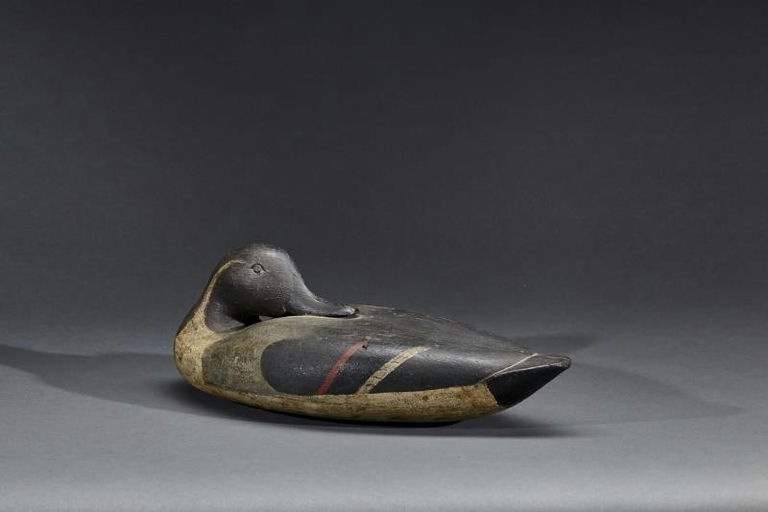
Richard Wistar Davids Early Sleeping Pintail Drake
Richard Wistar Davids (1825-1863) Philadelphia, PA, c. 1850
The catalog record
Richard Wistar Davids (1825-1863) Philadelphia, PA, c. 1850
Richard Wistar Davids (1825–1863) was the third son of Benjamin Davids and Rebecca Morris, a marriage of two Philadelphia Quaker merchant families. Davids was a Union officer in Company B, Pennsylvania 118th Infantry Regiment, killed in the Wheatfield during the Battle of Gettysburg.
Davids decoys are closely linked and bear striking similarities to the work of Albert Laing (1811-1886), who was Davids’ first cousin. Indeed the Laing bluebill, branded 'R.W. DAVIDS' and 'C W MORRIS' illustrated on p. 32 of Chitwood’s "Connecticut Decoys," was used along with this pintail in an Easton, Maryland, gunning rig as recently as the 1960s.
It is exceedingly rare in the realm of collecting to be able to document the lineage of decoys and rigs back more than just a generation or two. That was the case with this pintail drake for decades until Chesapeake Bay historian Pete Lesher filled in the family lineage of this gunning rig dating back before the Civil War.
This exemplary decoy bears the brand "C W Morris" for Caspar Wistar Morris. Thanks to Pete Lesher, Chief Curator at the Chesapeake Bay Maritime Museum, new information regarding the Morris family and their gunning heritage has cast light on the history of this important rig.
Regarding a rigmate pintail that bears both the 'C W MORRIS' and 'R. W. DAVIDS' brands, Lesher writes:
"The R. W. DAVIDS -branded decoy was acquired by Caspar W. Morris (1806-1877), Davids’ uncle, presumably after Davids’ death in 1863. Morris lived at Frankford, Pennsylvania, just across Delaware River from Riverton Yacht Club, where Morris served as commodore until 1875. Morris branded the decoy C W MORRIS.
“Caspar W. Morris’ son, Jacob Giles Morris (1835-1905) was a lifelong sportsman and yachtsman who was the next to use the rig. After his 1857 marriage to Isabel Fennell, he settled at Tacony on the Delaware River, but then relocated to Maryland in 1867. He purchased 173 acres on Hunting Creek, a branch of the Miles River along the Eastern Shore of the Chesapeake Bay, from Comm. Charles Lowndes. By the 1880s, Jacob Morris was sailing a cutter yacht named Cora, which he rerigged as a yawl. In addition to managing his Hunting Creek farm, he promoted the sport of yacht racing, joining with others to establish the Chesapeake Bay Yacht Club in 1885. He also took Cora on ducking cruises down the bay.
“Jacob Morris died in 1905, and after the death of his widow, Isabel, in September 1911, his Hunting Creek farm was sold and its contents dispersed. Morris’ son, Thomas Clifford Morris (b. 1858), lived in the family home with his mother at the time of her death. C. Lowndes Johnson, a neighbor of the Morrises, kept a diary and on June 13, 1912, he recorded, “Right after dinner Cliff Morris and Harry Rieman came around in H[arry]’s canoe with about 150 or more decoys and three heavy muzzle loader duck guns for us to keep for them. Harry had his 15 ft double end duck boat with him and I bought it from him for five dollars.
“C. Lowndes Johnson and his younger brother J. Graham Johnson (1883-1931), who later hunted with Dick Tilghman, purchased portions of this rig over the next several years, one portion of the rig referenced in a December 23, 1917 diary entry. Remnants of the rig remained in the loft of his boat shop when he died. Johnson’s incredibly varied rig came to include not only decoys branded 'C W MORRIS' and 'R.W. DAVIDS,' but decoys by a Jersey Shore carver, Blair school, Robert D. Lambdin of St. Michaels, and decoys carved by the Johnson boys themselves.”
Additional species and forms of Davids-Morris rig decoys include the aforementioned Lesher pintail drake, high-head pintail drake, a straight-head pintail drake, a preening black duck, and a preening redhead. Original paint with gunning wear, even craquelure, light flaking, and a possible second wash of white on bottom.
Provenance: Caspar Wistar Morris Rig, Frankfort, Pennsylvania Jacob Giles Morris Rig, Tacony, Pennsylvania and Easton, Maryland Thomas Clifford Morris, Easton, Maryland, by descent from the above Private Hunting Rig, Easton, Maryland, retired from rig, c. 1965 Private Collection, by descent from the above Private Collection, Nantucket, Massachusetts, acquired from the above
Literature: Henry C. Chitwood, Connecticut Decoys, West Chester, PA, 1987, p. 32, exact decoy illustrated.
Ronald S. Swanson, "Albert D. Laing: A decoy maker unequaled in his time," Decoy Magazine, Burtonsville, MD, July/August 1995, p. 14.
Richard W. Oliver, Rare and Important American Bird Decoys, Kennebunk, ME, July 1987, lot 97, exact decoy illustrated.
Pete Lesher, "New Additions to the R. W. Davids Rig," Decoy Magazine, Lewes, DE, November/December 2016, pp. 32-33, exact decoy illustrated.
Provenance
Caspar Wistar Morris Rig, Frankfort, Pennsylvania Jacob Giles Morris Rig, Tacony, Pennsylvania and Easton, Maryland Thomas Clifford Morris, Easton, Maryland, by descent from the above Private Hunting Rig, Easton, Maryland, retired from rig, c. 1965 Private Collection, by descent from the above Private Collection, Nantucket, Massachusetts, acquired from the above
Comparable sales
No other Richard Wistar Davids Pintails in the data yet.
Same maker and species, most recent first. Prices include the buyer's premium. All Richard Wistar Davids sales