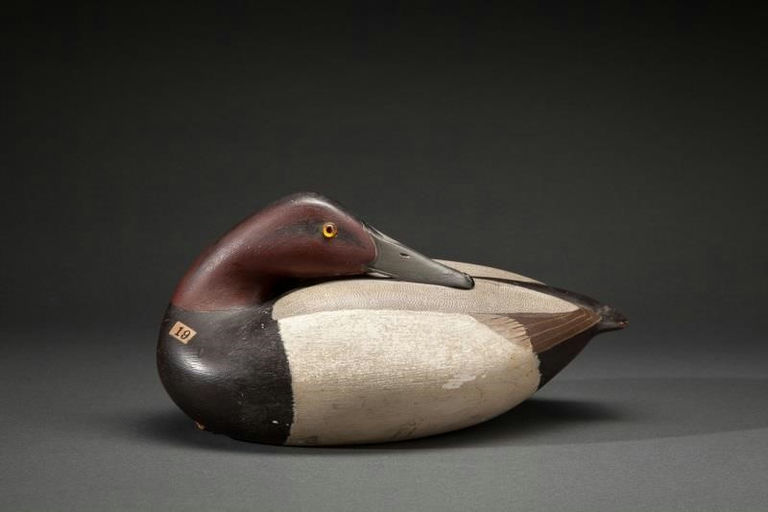
Shang Wheeler Preening Canvasback Drake
Charles E. "Shang" Wheeler (1872-1949) Stratford, CT, c. 1920
The catalog record
Charles E. "Shang" Wheeler (1872-1949) Stratford, CT, c. 1920 Charles Edward Wheeler is recognized as the most famous bird carver from Connecticut. While his predecessors Albert Laing (1811-1886) and Benjamin Holmes (1843-1912) made many gunning decoys of exceptional quality, it was Wheeler who took the art form to the next level, producing everything from sandhill cranes to sailfish. Shang, as everyone called him, was an enigmatic figure: oysterman, politician, boxer, cartoonist, public speaker, conservationist, and world-renowned decoy carver.
Author Dixon Merkt on Wheeler’s life:
"Wheeler’s concern with the conservation of nature eventually led him into politics. Over the years he had come to know and admire Teddy Roosevelt, and as a politician he adopted Roosevelt’s brand of progressive Republicanism. Himself a skilled ornithologist, former cowboy, and avid sportsman, Roosevelt had made conservation one cornerstone of his political platform. Wheeler followed in his footsteps. During several terms in the Connecticut General Assembly he led the campaign to pass anti-pollution and wildlife conservation legislation.
Unlike T.R., Wheeler had no driving ambitions. He went into politics because he wanted to clean up Connecticut’s harbors and river. He did much of the hard work and then let other men win the laurels. His ties to Roosevelt and later to Herbert Hoover might have lead him to high government office, if that had been his goal. But Wheeler was satisfied with the life he had built for himself around Stratford. He had many good friends; his work kept him outdoors; and each year he had time for hunting and fishing trips."
In 1923 Wheeler arrived on the competition carving scene with a bang. Public concern over the popular and devastating practice of dusking (or hunting after dark) had started to take shape. Led by conservationists including early historian, author, and collector Joel Barber, along with Paul Bigelow and John Boyle, the group started the Anti-Duskers Society. The Anti-Duskers sponsored one of the first decoy shows in North America on August 23rd at the public library in Bellport, Long Island. A carving competition held at the event was aimed at hunters in attendance to further advance the concept of shooting over decoys. The inaugural event attracted amateur and professional carvers from near and far, however, it was Wheeler who took home top amateur honors with his dynamic turned-head mallard drake. Joel Barber gave the winning decoy the highest praise possible lauding that it represented “the highest development yet reached in the American art of decoy carving.” As stated by Merkt and Lytle, “Wheeler carted off first prize at Bellport because he had introduced a new style to decoy painting.”
Canvasback decoys by Wheeler are exceedingly rare. Important examples are held in the Shelburne Museum, the Alan and Elaine Haid Collection, and a private New England Collection with relatively few others known to exist. Of the examples that have surfaced, the majority were made with cork bodies. This sterling example relates closely to Wheeler's prize-winning mallard which now resides in the Shelburne Museum. This canvasback was most likely carved for one of the early Bellport competitions as evidenced by the number nineteen competition sticker affixed to its breast. This grand preener displays all the elements that top Wheeler collectors look for. The head is artfully and accurately cranked around from the right side of the breast culminating with its pronounced crown. The accurately presented bill is heavily incised and shoots across the bird's back, touching down on the left side. The bird's overall proportions and intricate scratch-comb paint are spot on. In the creation of this decoy, Wheeler has produced a lasting tribute to “The King of Ducks" that ranks as one of the finest Connecticut decoys extant. Original paint with even wear, a few minor dings to head, and scrapes to body. Competition sticker number nineteen is still affixed to breast. Retains its original teardrop shaped weight and most of the original leather.
Literature: Dixon MacD. Merkt, "Shang. A Biography of Charles E. Wheeler," Spanish Fork, UT, 1984, p. 145, plates 131 and 132, similar decoy illustrated.
Comparable sales
The 4 most recent Shang Wheeler Canvasbacks to cross the block.
| Sold | Condition | Paint | Brought |
|---|---|---|---|
| Nov 2025 | — | Original | $8,400 |
| Jul 2025 | — | Original | $7,200 |
| Apr 2024 | Excellent | Original | $72,000 |
| Jul 2018 | — | Original | $7,200 |
Same maker and species, most recent first. Prices include the buyer's premium. All Shang Wheeler sales