Gus Wilson White-winged Scoter
Augustus "Gus" Aaron Wilson (1864-1950) South Portland, ME, c. 1900
The catalog record
Augustus "Gus" Aaron Wilson (1864-1950) South Portland, ME, c. 1900
"Wilson looked at waterfowl much the way the Ward brothers did. There was a similarity in their ability to capture an unusual pose and to produce a decoy that continues to enthrall even the seasoned gunners who have spent their lives observing waterfowl.” -Maine decoy author and historian, Captain John Dinan
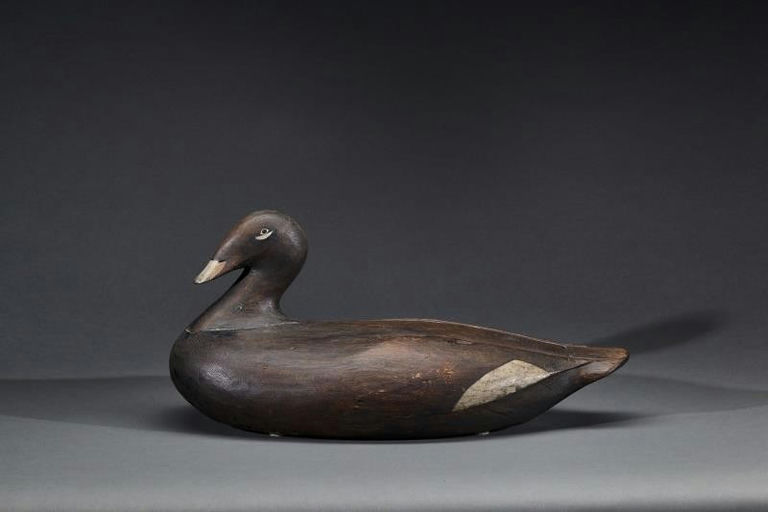
This bold carving features an inletted and turned head with painted eyes, refined bill detail, and raised wings. These Monhegan Island birds were made famous in Quintina Colio’s book "American Decoys" which featured four rigmates.
This grand bird is over seventeen and one-half inches long, and over eight inches wide. The two-piece construction features a prodigious inletted head seat.
Wilson was born on Mount Desert Island, Maine. Though he is foremost remembered as a carver, he was also a boat builder, waterman, outdoorsman, and lighthouse keeper. He was an attendant to a number of Maine’s lighthouses, including the Great Duck Island Light, Goose Rocks Station on Fox Island, Two Lights Station on Cape Elizabeth, Marshall Point Light at Port Clyde, and Spring Point Ledge Lighthouse in Casco Bay.
According to art historian Gene Kangas, “His job as a lighthouse keeper provided financial security and ample time to facilitate rapid artistic advancement. Imaginative decoys and wildlife carving began to take shape in an incredible variety of poses.” Early regional traditions and requirements drove carvers to produce big solid decoys with modest paint patterns. “Seaworthiness, durability, practicality, effectiveness and affordability were essential considerations...Wilson’s genius is demonstrated by his ability to work within those existing traditions, yet elevate the Maine decoy to a higher level of artistic achievement.”
Wilson’s interests were by no means limited to decoys. He carved a variety of songbirds, decoratives, weathervanes, and big cats. A pair of Wilson’s tigers are featured in the American Identities exhibit, on display as a part of the permanent collection of the Brooklyn Museum, Brooklyn, New York.
Original paint with even wear mostly down to wood, faint age line in the head reglued, and gunning wear.
Provenance: Private Collection, Nantucket, purchased from Samuel Lowe Antiques, Charles Street, Boston, Massachusetts, in 1977, selected from a rig of six Wilson decoys
Literature: Gene Kangas, “Gus Wilson, Folk Artist,” Decoy Magazine, Lewes, DE, November/December 1994, pp. 8-13. Quintina Colio, "American Decoys," Ephrata, PA, 1972, pp. 30-31. Joe Engers, ed. "The Great Book of Wildfowl Decoys," San Diego, CA, 1990, pp. 36-41.
Provenance
Private Collection, Nantucket, purchased from Samuel Lowe Antiques, Charles Street, Boston, Massachusetts, in 1977, selected from a rig of six Wilson decoys
Comparable sales
The 5 most recent Gus Wilson Scoters to cross the block.
| Sold | Condition | Paint | Brought |
|---|---|---|---|
| Jul 2026 | — | — | $3,900 |
| Jul 2026 | — | Original | $1,140 |
| Mar 2026 | — | Repaint | $930 |
| Feb 2026 | — | Original | $3,900 |
| Jan 2026 | — | Repaint | $1,800 |
Same maker and species, most recent first. Prices include the buyer's premium. All Gus Wilson sales