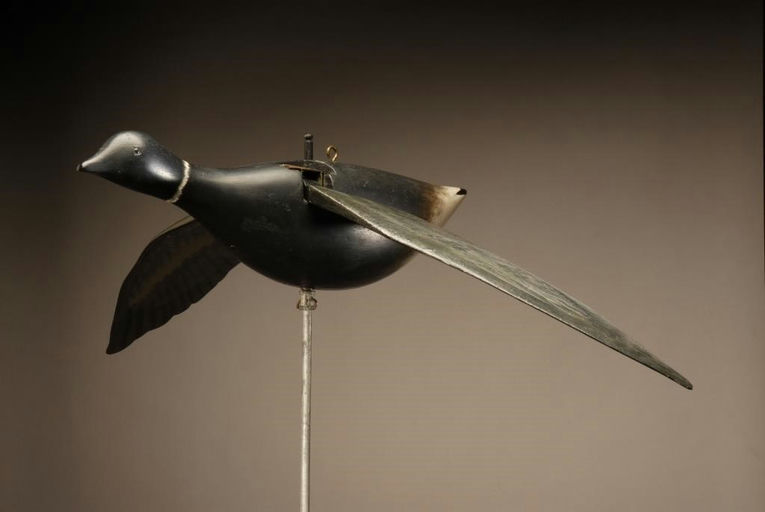
George William McLellan Exceptional Flying Mechanical Brant
George William McLellan (1897-1987) Eureka, CA, c. 1941
The catalog record
George William McLellan (1897-1987) Eureka, CA, c. 1941 One of only nine flying brant from this important rig. Few would argue that McLellan’s famous rig of brant are the finest flyer decoys ever created. This rig was painstakingly constructed in 1941 with his wife Olga’s help. West Coast decoy authorities, Michael Miller and Frederick Hanson describe these famous flyers as “masterpieces of precision” in their book Wildfowl Decoys of the Pacific Coast: Carving Traditions of British Columbia, Washington, Oregon and California. McLellan, even during his lifetime, recognized the important value of these decoys “for he made a special box for them that contained separate compartments for wings, pins, dowel, bodies, ect. The redwood bodies, measuring about 24 inches in length, were fashioned from old telephone poles found in the alley behind his home. Bill created nicely detailed patterns to trace the top and side views on the redwood blocks before he started carving. Unlike the floaters, Bill did not equip these flyers with bills made of hardwood doweling. The wings were constructed in much the same manner as those on good model airplanes. McLellan used fine spruce for the frames, after first designing and preparing explicit patterns. When the frames were completed, stiff butcher paper was laid on followed by muslin. The fabric was then coated with airplane dope. The wing patterns were taken from the tracing of an actual brant wing – “a big fella” according to McLellan. Each of the nine flying brant was numbered on the body and matching wings. The latter fit into the bodies with intricate, brass wing-locking mechanisms that allow quick removal or attachment (see detail). The wing-lock is hinged to allow the wings, rigged with heavy rubber bands, to waver in the wind. A copper pin secures the wings to the hinges. The flyers were deployed by means of telescoping 2-piece galvanized steel poles. Each of the nine poles, with each decoy at a different height, was attached to a floating wooden frame that was pulled over the sand into the water as the tide rose and fell” (Miller and Hanson, p. 132). One of, if not the best of the nine that McLellan made, this brant is the exact decoy Miller and Hanson chose to feature in color plate 6.5 of their historic publication. Superb overall condition, one would be very hard pressed to find a better example. Original in all aspects including the original telescoping pole and original carrying box, a minor black rub along the bottom of the body.
Literature: Joe Engers, ed., The Great Book of Wildfowl Decoys, San Diego, CA, 1990, pp. 269-270. Michael R. Miller and Frederick W. Hanson, Wildfowl Decoys of the Pacific Coast: Carving Traditions of British Columbia, Washington, Oregon and California, Davis, CA, 1989, pp. 129-133. Rich Wheeler, “Bill McLellan- Wonderful Flying Brant” Decoy Magazine, Lewes, DE, March/April 1989, pp. 36-41.
Comparable sales
The 2 most recent George William McLellan Brant to cross the block.
Same maker and species, most recent first. Prices include the buyer's premium. All George William McLellan sales