Robert Andrews The Andrews Running Curlew
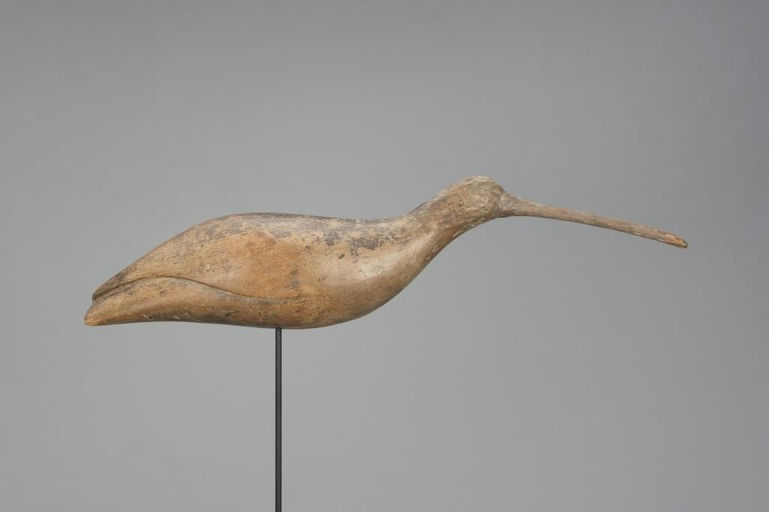
Capt. Robert Andrews Smith Island, VA, c. 1880
The catalog record
Capt. Robert Andrews Smith Island, VA, c. 1880 18 1/2 in. long
Named for Captain John Smith who visited the island in 1608, Smith Island has a long and intriguing history, including the small island’s notable decoy-making heritage. Captain George Hitchens was the commander of Smith Island’s lifesaving station from c. 1880 to 1915. In his charge were three of the region's top decoy makers, Capt. Robert Andrews, Almer Fitchett, and John Henry Downes. This talented trio created, used, and exchanged decoys while together on the island.
This monumental curlew was made by Capt. Robert Andrews. His decoys are perhaps the rarest of the region's top makers. This distinctly Smith Island curlew stands today as the most iconic remaining decoy from the isle and the best of its kind to come to light. The sculpture’s simplified form and confident sweeping lines are unique to this talented Southern maker. The long-reaching body resolves with the region’s most elegant wing carving.
The large incised “H” in the underside is the ownership marking of Andrews' colleague John Henry Downs. Roy Bull, who lived just across Magothy Bay from Smith Island, sourced this decoy for his collection. In 1983 it came to the public’s attention in the Bull Collection auction catalog. It is prominently featured on the back dust jacket cover of “Southern Decoys." It has long been admired by collectors as no finer example has yet surfaced.
Thomas Dixon, Jr. writes of hunting on the island in 1903: “May 17 we reached the Life Saving Station of Smith's Island, by the invitation of its genial bronzed Captain George Hitchens. It was blowing a furious gale and raining in blinding sheets, with the wind hanging steadily on to the northeast.
The birds had not come, the crew told us, but Captain George said they would come in on the wings of the storm that night. At daylight we caught the old plug of a horse from the stable and hitched him to the cart. The Smith's Island Light, just over our heads, the greatest light of the Atlantic coast, was still flashing its gleaming message, '45,' over the storm-clouded sea.
Within an hour we had reached the bend of the beach, five miles above the station. The tide had just begun to ebb as the sun burst from the ocean through the cloud-banks of the passing storm.
The captain was right. The birds had come on its black wings. The beach was literally covered with them. We were in rare luck. We were the first on the beach, the first day of their season, and the wind was blowing a steady gale from sea, just the way we wished it.
Hastily gathering some dead bushes and grass from the sand-dunes, we build a scraggy blind, place our decoys on the edge of the receding surf, and are ready for them.
How beautifully they come!” “The Shore-Birds of Old Virginia” Country Life in America, September 1903 Original paint mostly worn to wood with gunning wear. Roughness to head and replaced bill.
Provenance: John Henry Downes Rig Roy Bull Collection Henry and Barbara Fleckenstein Collection Barbara Anne Wiest (Fleckenstein) Collection Private Collection, by descent from the above
Literature: Richard A. Bourne, Inc., “The Roy Bull Decoy Collection,” Hyannis, MA, March 1983, lot 288, exact decoy illustrated. Henry A. Fleckenstein, Jr., "Southern Decoys of Virginia and the Carolinas," Exton, PA, 1983, back dust jacket cover, p. 166, pl. 322, exact decoy illustrated.
Provenance
John Henry Downes Rig Roy Bull Collection Henry and Barbara Fleckenstein Collection Barbara Anne Wiest (Fleckenstein) Collection Private Collection, by descent from the above
Comparable sales
The 1 most recent Robert Andrews Curlew to cross the block.
| Sold | Condition | Paint | Brought |
|---|---|---|---|
| Jul 2008 | — | — | $4,600 |
Same maker and species, most recent first. Prices include the buyer's premium. All Robert Andrews sales