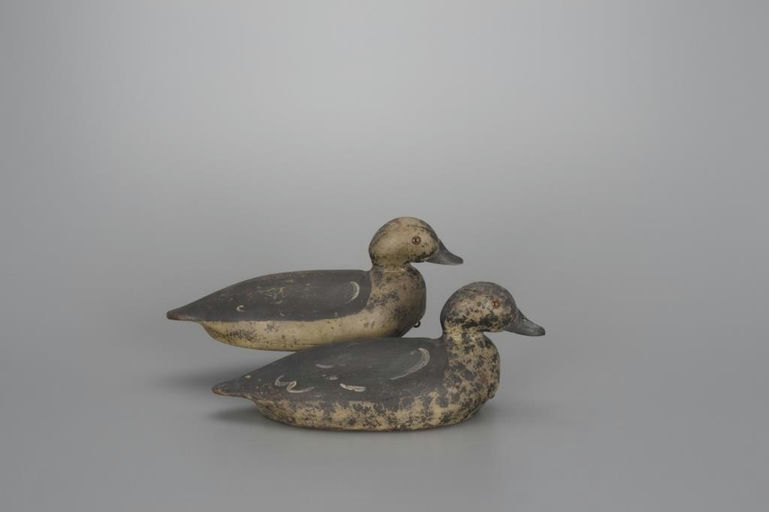
Nate Quillen Blue-winged Teal Pair
Nathaniel "Nate" Quillen (1839-1908) Rockwood, MI, c. 1885
The catalog record
Nathaniel "Nate" Quillen (1839-1908) Rockwood, MI, c. 1885 10 in. long
“Of all the marsh ducks turned out by Quillen, teal apparently were the most rare.” - Bernie Crandall
Prior to the discovery of this pair, Quillen scholars had previously identified only three teal decoys. The rarity of Quillen decoys in original paint is addressed by Donna Tonelli in her thorough article on the maker. She states that “there are only a dozen or so original paint Quillens known in collections today, including three blue-winged teal decoys…” Thus, this lot represent the fourth and fifth known Quillen teal and a significant portion of the known Quillens in original paint.
Quillen was a well-respected punter, or guide, at the prestigious Pointe Mouillee Shooting Club at the mouth of the Huron River. A 1922 history of the club refers to their talented punter as “an artist as well as an artisan.” During the offseason Quillen was a cabinetmaker and locksmith and his fastidious craftsmanship is evident in the decoys he created.
Crandall states that, because of their unique construction, Quillen decoys have been “recognized as highly desirable examples of perfectionism in the decoy making art and have drawn praise ranging from ‘highly unusual’ to ‘spectacular.’” He explains, “Quillen’s shop, adjacent to his small frame house, included a sawmill for rough cutting logs, and all the tools of a master carpenter and locksmith. He was as meticulous in the preparation of the wood as he was in his carving.”
Fellow carver, Jim Foote, documented the exhaustive processes Quillen employed in making his early hollow decoys. He began by selecting and harvesting white cedar that he would dry for at least a year. Quillen would then rough out the bodies and allow them to season for another year. The rough cuts would then be carved to completion with inset heads, thin necks, shoulder carving, and thin hollowed bodies. The carved bodies were then shelved for another year. Those that developed imperfections during these years of seasoning were discarded and only the best bodies were painted. The painted decoys were again allowed to dry thoroughly before they would be sold. The buyers of these premium decoys were affluent club members who paid four times the going rate of lesser decoys.
Crandall closes his account of this great artisan by acknowledging that “there were no decoy makers who attempted to copy his decoys. The fine carpentry and the hours needed to turn out these little masterpieces were just too much for anyone but a perfectionist, or another Quillen, to face.”
Branded "G.A.S." on the bottom boards for Pointe Mouillee Shooting Club member Gus A. Schwartz. Original paint with gunning wear, including a small rough area on the back of one decoy and both have a lower half bill repair.
Provenance: Gus A. Schwartz Rig Private Collection
Literature: Bernard Crandall, "Nate Quillen Decoys," North American Decoys Magazine, Spring 1972, front cover and pp. 2-11, related decoys illustrated. Donna Tonelli, "The Legend of Nate Quillen & the Pointe Mouillee Shooting Club," Decoy Magazine, Lewes, DE, March/April 2003, pp. 8-15, related examples illustrated. Bernard W. Crandall, "Decoying: St. Clair to the St. Lawrence," Erin, ON, 1988, pp. 56-57.
Provenance
Gus A. Schwartz Rig Private Collection
Comparable sales
The 1 most recent Nate Quillen Blue-winged Teal to cross the block.
| Sold | Condition | Paint | Brought |
|---|---|---|---|
| Apr 2023 | — | Original | $81,000 |
Same maker and species, most recent first. Prices include the buyer's premium. All Nate Quillen sales