The catalog record
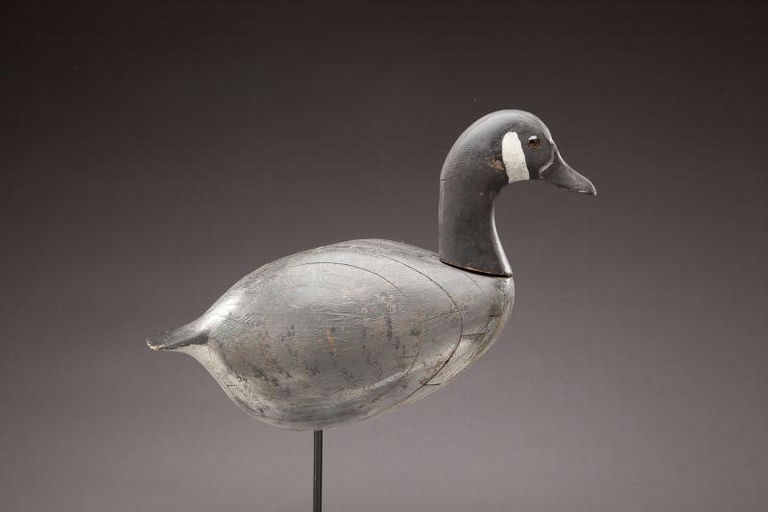
John Tax (1894-1967) Osakis, MN, c. 1917 A rare, hollow, vertically-laminated cedar, stick-up field decoy by this famous Minnesota maker. One of if not the plumpest of the rig, this superb example displays subtle but defined combscratched paint not typically seen on other Tax goose decoys. Gene and Linda Kangas, noted decoy authors and historians, in their book Decoys: A North American Survey, write "Tax’s full-bodied, stick-up Canada and snow geese rank as his most important works. While the massive bodies of both species are similar, each decoy was endowed with a different head position, depicting either a feeder, nestled head or sentinel attitude. The heights, angles, and curves were varied on each so that no two were exactly alike, thus contributing to a more lifelike rig. Painting was sufficient to accurately depict each species; but, it is a marvelous sense of power and dynamic form that marks his field “stick-up” as a noteworthy contribution to decoy history."
John Tax’s entire gunning rig consisted of approximately seven dozen waterfowl and goose decoys. They were purchased from the Tax family in the late 1960’s by fellow Minnesota natives John Lindgren and Cliff Traff of Minneapolis. Many of the best examples from this rig were exhibited at the Milwaukee Decoy show in 1969. At the suggestion of some of the “old-time” collectors, the two published a booklet documenting eighty-four known examples of John Tax’s work. Published in 1970, Last of the Prairie Carvers illustrates the nineteen Tax “stick-up” or field goose decoys known to exist at that time. Of the nineteen, eight were snow geese and eleven were Canada geese. Little information is available regarding John Tax, however, it is known that he earned a living as a professional harness maker. This profession explains the availability of the tools necessary for Tax to have crafted these labor-intensive hollow laminated decoys. Another notable fact regarding John Tax and his unique decoys is the documentation of an original sets of Audubon prints in his possessions at the time of his death. In “Minnesota Memories: An Interview with John Tax, Jr.,” written by Laurence Rucker, the author writes, “Tax used Audubon prints as references when carving and painting his decoys.” Original paint with craquelure, gunning wear and a three small repairs to body lamination edges.
Provenance: Private Collection, Cambridge, Massachusetts
Literature: John Lindgren and Cliff Traff, "The Last of the Prairie Carvers: Decoys by John Tax," 1970. Gene and Linda Kangas, "Decoys: A North American Survey," Spanish Fork, UT, 1983, pp. 302-303. Alan Haid, "Decoys of the Mississippi Flyway," Exton, PA, 1981, p. 66. Gene and Linda Kangas, "Great Lakes Decoy Interpretations," OH, 2011, p. 216.
Provenance
Private Collection, Cambridge, Massachusetts
Comparable sales
The 4 most recent John Tax Canada Geese to cross the block.
| Sold | Condition | Paint | Brought |
|---|---|---|---|
| 24 Apr 2025 | — | Original | $48,000 |
| 24 Apr 2025 | — | Original | $2,400 |
| 24 Apr 2025 | — | Original | $1,800 |
| 17 Jan 2011 | — | Original | $115,000 |
Same maker and species, most recent first. Prices include the buyer's premium. All John Tax sales