Mason Decoy Factory The Peabody Essex Long-billed Curlew
Mason Decoy Factory (1896-1924) Detroit, MI, c. 1900
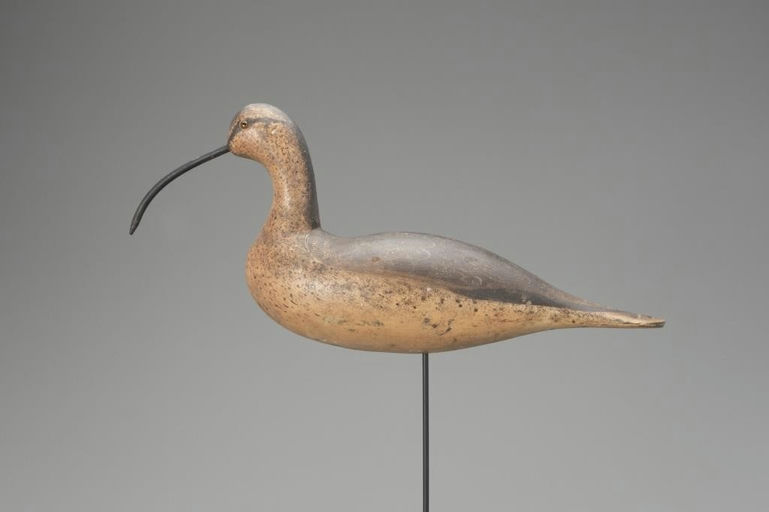
The catalog record
Mason Decoy Factory (1896-1924) Detroit, MI, c. 1900 18 in. long
The provenance of this decoy was not listed when it last sold in April of 2000. Writing for "Decoy Magazine" after the auction in 2000, Jackson Parker discusses this exact bird, stating, "I thought it was equal or better than the McCleery curlew which was loaded with provenance." Collectable Old Decoys owner Dick McIntyre, who procured the decoy for the consignor concurred, writing at the time, "the best one I've ever seen!"
Parker in hispost auction article goes on to reveal The Peabody Essex Museum as the consignor. Evidently, the museum had acquired this curlew in 1945 and it had remained in their collection for fifty-five years. Parker also states the museum's reason for deaccessioning the curlew: "...to provide funds for the acquisition of Massachusetts classics."
The museum’s “SB 16” code is painted under the tail.
In their 1993 publication on Mason decoys, Goldberger and Haid discuss curlew by Mason as being “huge; the bodies alone are 12-inches long.” This larger example measures thirteen and one-quarter inches from the tip of the tail to the front of the breast.
William J. Mackey, Jr. writes in Classic Shorebird Decoys: A Portfolio of Paintings, "Mason's skilled company of woodworkers and artists turned out numerous fine decoys...The Mason curlew...in original paint...would be one of the finest of factory shorebirds. Mason's paint was of unusual high quality...it has mellowed with age, but still retains the original luxurious, gemlike coloring. The method of application was also peculiar to Mason decoys. The paint is applied in a swirling pattern that made it stand up well against the roughest treatment and the saltiest Atlantic tidewaters. The painting style of Mason's decoys is fixed in a traditional, rather rigid pattern, but there is never a feeling of monotony, but rather one of rich ornamentation."
This decoy exhibits the finest work of Mason's painters. Unrestored and in near mint condition, with excellent provenance, it ranks as one of the top Mason decoys known to exist. Original paint with light gunning wear, and an age line on the underside.
Provenance: Mrs. Edward Eldredge Collection Peabody Essex Museum Collection, gifted from the above, 1945 Mark Smith Collection, acquired 2000
Literature: Milton C. Weiler and William J. Mackey, Jr., "Classic Shorebird Decoys: A Portfolio of Paintings," New York, NY, 1971, pl. 12. Russ J. Goldberger and Alan G. Haid, "Mason Decoys: A Complete Pictorial Guide," Burtonsville, MD, 1993, pp. 106, 107, 136, and back dust-jacket cover, similar decoys illustrated. Alan G. Haid and Brandy S. Culp, "The Allure of the Decoy," Charleston, SC, 2013, p. 61, similar decoy illustrated. Jackson Parker, "Auction News," Decoy Magazine, May/June 2000, pp. 40-42, p. 40, exact decoy illustrated.
Provenance
Mrs. Edward Eldredge Collection Peabody Essex Museum Collection, gifted from the above, 1945 Mark Smith Collection, acquired 2000
Comparable sales
The 5 most recent Mason Decoy Factory Curlews to cross the block.
| Sold | Condition | Paint | Brought |
|---|---|---|---|
| Jul 2026 | — | Original | $2,100 |
| Dec 2025 | — | Original | $2,280 |
| Nov 2025 | — | Original | $2,400 |
| Jul 2025 | — | Original | $66,000 |
| Apr 2025 | — | Original | $28,800 |
Same maker and species, most recent first. Prices include the buyer's premium. All Mason Decoy Factory sales