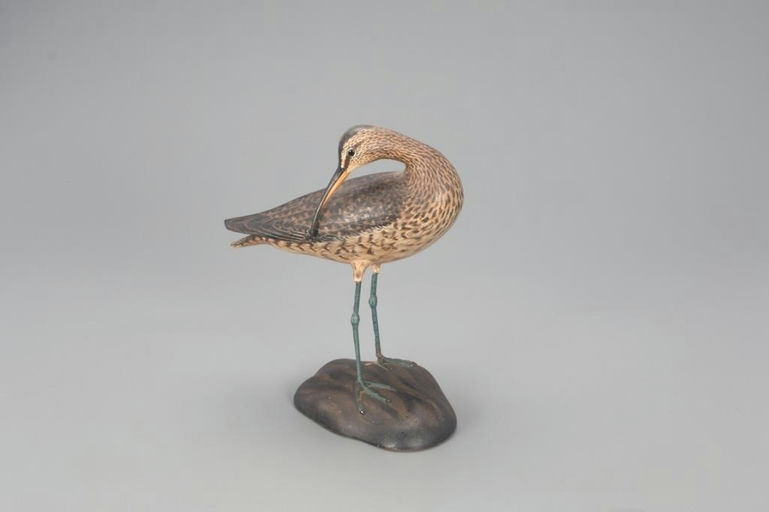
Elmer Crowell The Du Pont Preening Curlew
A. Elmer Crowell (1862-1952) East Harwich, MA, 1941
The catalog record
A. Elmer Crowell (1862-1952) East Harwich, MA, 1941 9 in. long, 11 in. tall
Works like this curlew have been celebrated since their creation, with examples from Crowell’s studio going to the mantles of the du Pont, Ford, Forbes, and Rockefeller families, among others. His decorative shorebirds were wildly popular among these early patrons of the arts and curlew took the lead. Today, the two top prices ever paid for decorative shorebirds at auction are both Crowell running curlew. The species, posture, execution, condition, rarity, and provenance of this du Pont Collection carving place it as one of the best decoratives to enter the market in some time.
This represents an exceedingly rare species in an exceptional pose by the "Father of American Bird Carving." A study of the maker’s portfolio reveals that the preening posture is found in many of Crowell’s most collectable pieces. Requiring a level of craftsmanship that few carvers have demonstrated, Crowell relished the challenges presented in both form and paint. In "Elmer Crowell: Father of American Bird Carving," authors O'Brien and Olney cite the carver’s friend Joseph C. Lincoln who explains how the maker first began carving this posture: “...in filling one order from a wealthy customer, he let himself go. He made ducks with their heads turned backward, as ducks do turn their heads, when preening their feathers..."
This life-size mantle carving exhibits a graceful arching head accentuated by the perfectly curved bill. This feature spans high across the body to hover its bill just off of the primary feathers. The finest imported glass eyes are set within eye grooves above full cheeks, a feature not often seen in the maker’s work. Crowell’s attention to detail is remarkable with an incised mandible, nostrils, and tail feathers.
The bird's paint, gently blended, is an accurate portrayal of a curlew, also known as a whimbrel, exhibiting intricate feather detail with excellent wet-on-wet blending. While the final layer of paint was still wet, the maker applied contrasting-color delineations. Once the contrasting paint became tacky, he took a clean, dry brush and gently feathered the two colors together, producing his noteworthy blended effect. The maker’s ability, coupled with his patience and high personal standards, enabled him to create the blended paint which subsequently became known as the “Crowell style.”
This base retains Crowell's elegant cursive signature on the underside reading “A. E. Crowell Cape Cod 1941." It is also marked with his rectangular stamp. Excellent original paint with minimal wear, some touch-up to thigh putty and belly around thighs, a paint flake under the neck has been darkened, left foot is missing back toe.
Provenance: William K. du Pont Collection
Literature: Stephen B. O'Brien Jr. and Chelsie W. Olney, "Elmer Crowell: Father of American Bird Carving," Hingham, MA, 2019, pp. 144 and 148 and inside back cover, related carvings illustrated. Richard A. Bourne Co. Inc., "Rare American Decoys and Bird Carvings," July 13 and 14, 1982, lot 529, front cover, similar example illustrated.
Provenance
William K. du Pont Collection
Comparable sales
The 5 most recent Elmer Crowell Curlews to cross the block.
| Sold | Condition | Paint | Brought |
|---|---|---|---|
| Jul 2026 | Excellent | Original | $51,000 |
| Apr 2026 | Mint | Original | $192,000 |
| Apr 2026 | Excellent | Original | $138,000 |
| Feb 2026 | — | Original | $2,880 |
| Nov 2025 | Excellent | Original | $114,000 |
Same maker and species, most recent first. Prices include the buyer's premium. All Elmer Crowell sales