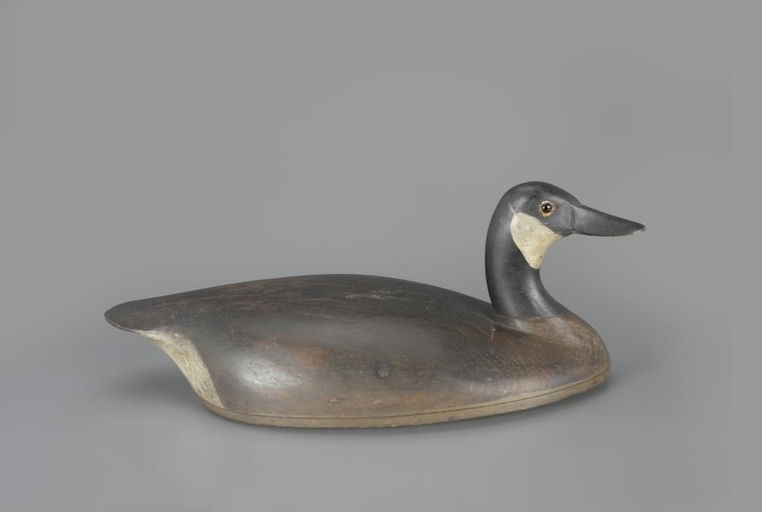
Thomas Chambers The Chambers Deming-seitz Canada Goose
Thomas Chambers (1860-1948) Wallaceburg, Ontario, Canada, c. 1915
The catalog record
Thomas Chambers (1860-1948) Wallaceburg, Ontario, Canada, c. 1915 22 in. long
Thomas Chambers (1860-1948) was born in Toronto, Ontario. He hunted ducks and geese as a boy and sold his excess quarry to the market. He later worked for Canadian sportsmen at the St. Anne’s Club on the Johnson Channel, which flows into Lake St. Clair. In 1900, the St. Clair Flats Shooting Company’s first president, George Warin (1830-1905) recommended Thomas Chambers for the position of full-time marsh manager of the club.
Incorporated in 1876, the St. Clair Flats Shooting Company was one of the oldest hunting clubs on Lake St. Clair. Chambers lived on the club’s property in an adjacent house with his wife and three children. Chambers would remain its manager until his retirement in 1943. According to author Bernard Crandell, it was during this time as manager that the 6 foot 1 inch Chambers earned the nickname "King Tom." Over the years, the membership of St. Clair Flats Shooting Company gradually changed from all Canadians to predominantly Americans.
In addition to his work for the Club, “King Tom” was also one of the nation’s most accomplished carvers. His decoys were in high demand from the members and even during the Depression a rig of a dozen Chambers decoys would command the unheard of price of $75. The bottom board of this hollow decoy is branded "THOS. CHAMBERS." The absence of his "MAKER" brand presents the possibility that this decoy was from Chamber's personal gunning rig. It is also branded “P. H. D.” and retains its “P. H. DEMING” painted stencil. Paul H. Deming was a St. Clair Flats Shooting Company member from 1912-1955.
The condition of this decoy can, in part, be explained by the sparse usage of goose decoys due to the historically low number of this species in the region. Less than a dozen of these geese in original paint are known today. With its exceptional form and provenance, this bird ranks as one of Canada's finest goose decoys.
Of a closely related decoy, Julie Hall, a folk art historian, wrote in 1976, "Such a beautiful prize in original paint with complete history is a rare find today." Original paint with even gunning wear, several tight age lines along back. A thin strip of olive green paint was added to seal body seams of this rig.
Provenance: Paul H. Deming Rig Joe Tonelli Collection Spencer Seitz Collection The George Secor Decoy Collection to Benefit Delta Waterfowl
Literature: Patricia Fleming and Thomas Carpenter, eds., "Traditions in Wood: A History of Wildfowl Decoys in Canada," Altona, ON, 1987, p.141, related decoy illustrated. Julie Hall, "Collectible Decoys--- An Endangered Species?" North American Decoys, Spanish Fork, UT, Summer 1976, p. 20, related decoy illustrated. Bernard W. Crandell, "Decoying: St. Clair to the St. Lawrence," Erin, ON, 1988.
Provenance
Paul H. Deming Rig Joe Tonelli Collection Spencer Seitz Collection The George Secor Decoy Collection to Benefit Delta Waterfowl
Comparable sales
The 2 most recent Thomas Chambers Canada Geese to cross the block.
| Sold | Condition | Paint | Brought |
|---|---|---|---|
| 27 Apr 2023 | — | Original | $27,000 |
| Jul 2017 | — | Original | $22,800 |
Same maker and species, most recent first. Prices include the buyer's premium. All Thomas Chambers sales